

Knife safety, whittling and improvised tools
If you're new to the world of bushcraft and survival, you will eventually come across knives. However, if you're considering buying a knife but are not sure which, then please visit our knife laws page first to make an informed choice.
In bushcraft, a knife is the most fundamental and essential tool. While wilderness survival relies on a heavy-duty, jack-of-all-trades blade for emergency tasks, a bushcraft knife serves as a precision woodworking instrument. It is used to process wood into camp tools, carve notches, and prepare food. [1, 2, 3, 4, 5]
Key Design Characteristics
Because bushcraft focuses on creating what you need directly from the environment, bushcraft knives are specialised for woodcraft and fine control. [1, 2]
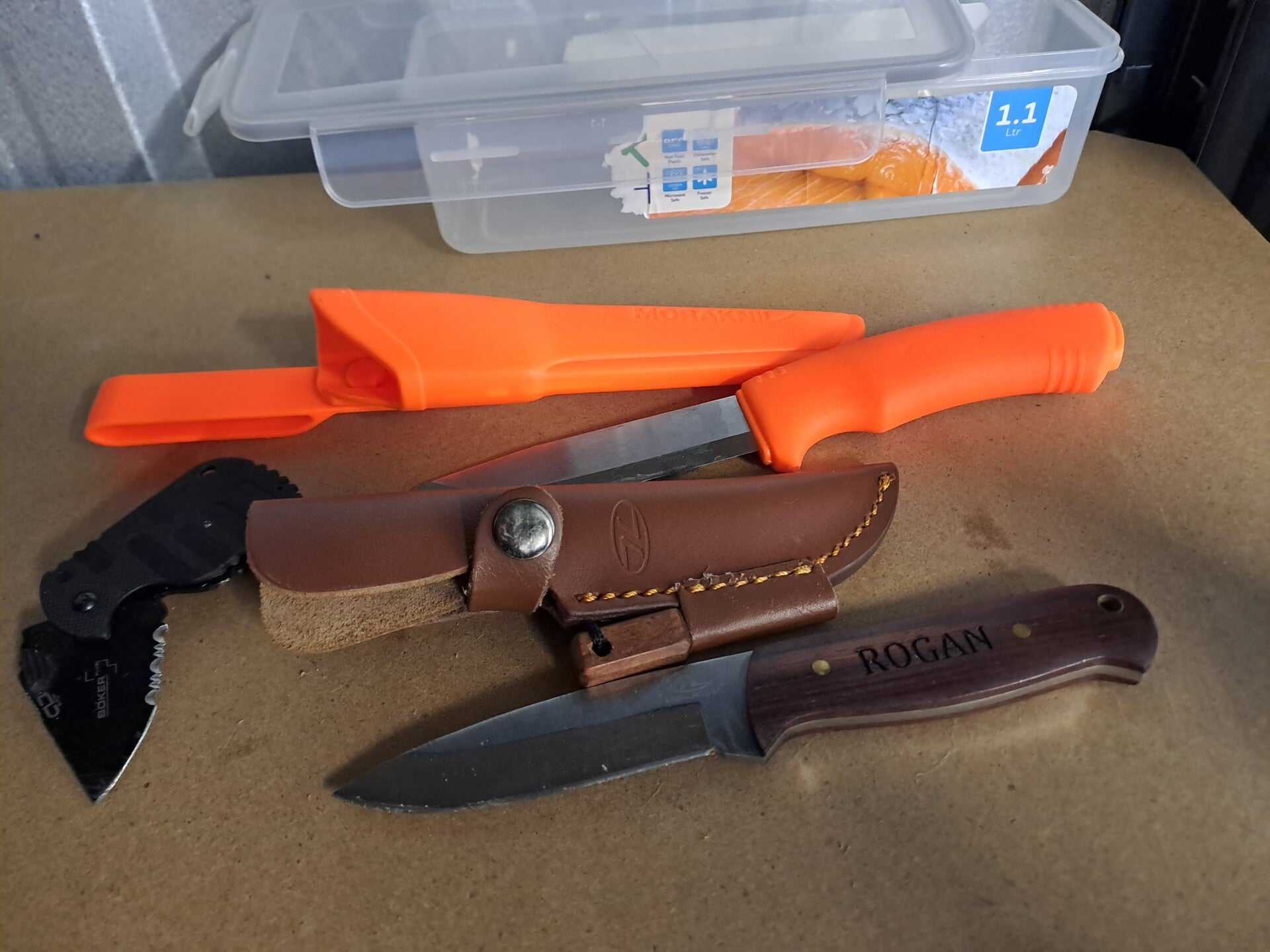
- The blade typically ranges from 3.5 to 5 inches in length with a medium thickness. The standard is a "Scandi" (Scandinavian) grind—a simple V-shaped edge running straight to the point without a secondary bevel. This makes it highly efficient for carving and easy to sharpen in the field. [1, 2, 3]
- The Construction: Practitioners typically prefer a full tang (where the metal extends completely through the handle) or a sturdy stick tang for durability. [1, 2]
- The Steel: High-carbon steel is traditionally favoured over stainless because it is easy to hone and can strike sparks when used with a ferrocerium rod. [1, 2, 3]
Bushcraft Knife vs. Survival Knife
The difference between the two lies in their intended purpose and scope: [1, 2]
- Bushcraft Knives: Specialised for carving, crafting, and making other tools. Because bushcrafters typically carry a combination of tools (like an axe or saw), the knife doesn't need to be an oversized chopper. [1, 2, 3, 4, 5]
- Survival Knives: Designed to function as a single, one-tool option. They are generally larger, heavier, and thicker, built to withstand heavy tasks like prying, digging, and batoning, where finesse is sacrificed for brute strength. [1, 2, 3]