

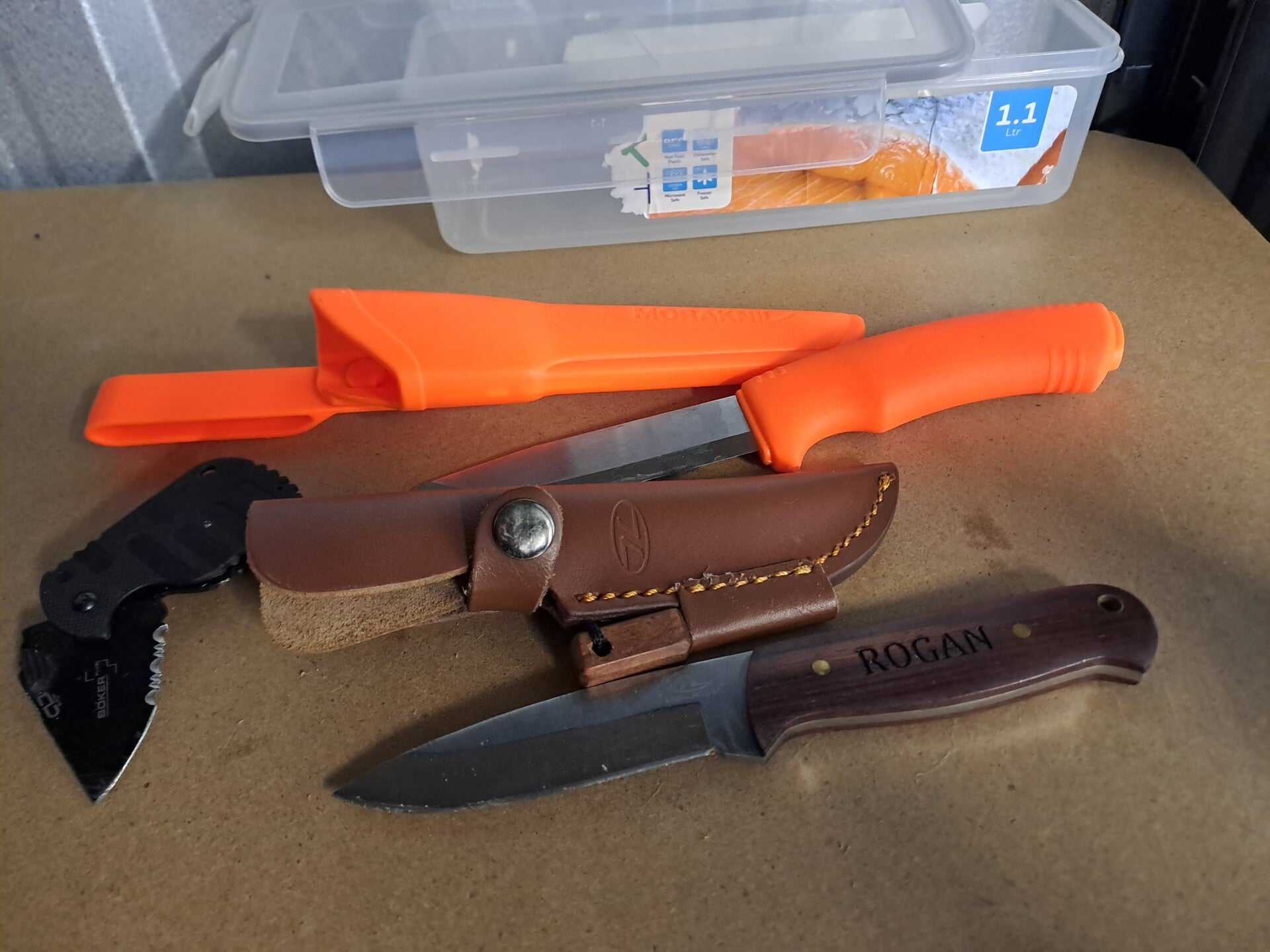
Knife laws
In the UK, carrying a fixed-blade or locking survival knife in public without a "good reason" is illegal. You may only carry large survival blades or lock knives if you are travelling to a specific, legitimate activity, such as wild camping, bushcraft, or hunting. Self-defence is never a valid reason. [1, 2, 3, 4, 5, 6, 7]
The General Rule (Everyday Carry)
Without a specific reason, the only knife you can legally carry in public is a non-locking folding knife with a cutting edge of 3 inches (7.62 cm) or less. Both conditions must be met. [1, 2, 3]
Survival Knives and The Outdoors
True survival or bushcraft knives often feature fixed blades or locking mechanisms. Under UK law (specifically the Criminal Justice Act 1988), carrying these in public requires a "good reason". [1, 2, 3]
- Wild Camping / Hiking: Carrying a fixed-blade or locking knife deep in your rucksack for wilderness tasks (food prep, cutting cord) is generally accepted as a valid reason. [1, 2]
- The Catch: You must only have the knife on you when and where it is needed. You cannot carry it casually into a town centre, a pub, or a non-camping area. [1, 2, 3, 4]
- Transportation: The knife should be kept securely stored in your backpack, preferably in a protective sheath, rather than worn openly on your belt while travelling. [1]
Completely Banned Knives
Regardless of your intentions or where you are, certain knives are prohibited from being owned, sold, or carried under any circumstances. These include: [1]
- Flick knives and switchblades
- Butterfly knives (balisongs)
- Gravity knives
- Zombie knives and disguised/stealth knives [1, 2, 3, 4, 5]
Penalties
Carrying a knife illegally in public can lead to severe consequences, including up to 4 years in prison and an unlimited fine. [1]
For more official information and to review the legislation, you can check the GOV.UK Knife Law Guidance or detailed breakdowns on the Heinnie Haynes Knife Law Guide. [1, 2, 3]